
See Connections
Map people, companies, agencies, providers, documents, dates, events, locations, claims, defenses, damages, ownership structures, memberships, and missing records.
CaseBuilder helps legal teams find the connections hidden inside discovery. It maps people, companies, agencies, providers, documents, dates, events, locations, claims, defenses, damages, ownership structures, memberships, and missing records so attorneys can see the case, not just the documents.
Find the connections. Build the case.
Traditional document review shows a folder of files. CaseBuilder shows the relationship network inside those files.
A case is often built because one document connects to another document, which connects to a person, a company, a timeline event, a missing record, a policy, a provider, an agency, or an issue. CaseBuilder is designed to make those connections visible.
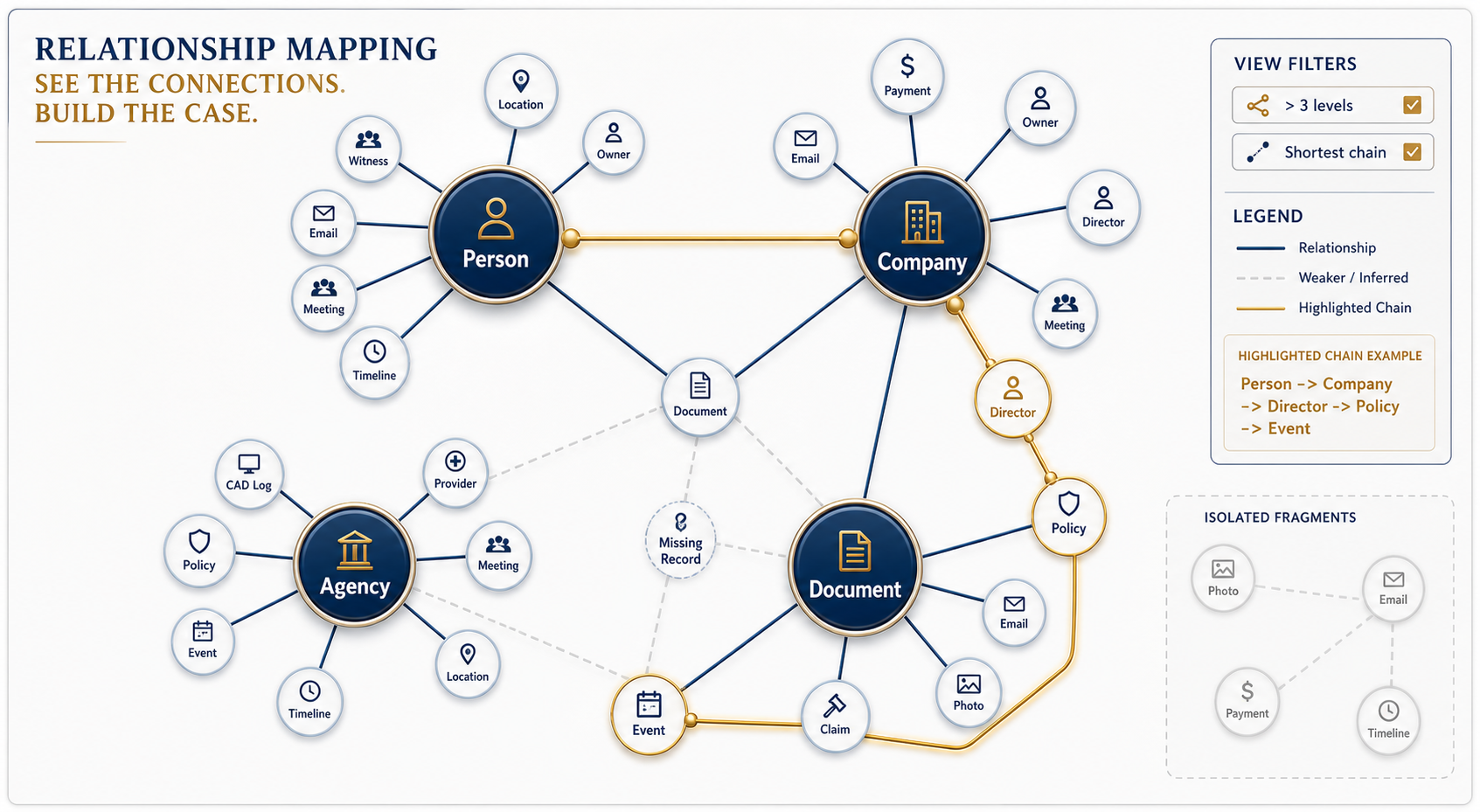
A date in a medical record may connect to an email. A name in an incident report may connect to a witness statement. A CAD entry may connect to a response-time dispute. A missing attachment may connect to a discovery gap.
Map people, companies, agencies, providers, documents, dates, events, locations, claims, defenses, damages, ownership structures, memberships, and missing records.
Understand not only what each record says, but why it matters and how it fits into the factual structure of the case.
Use connected case intelligence for issue spotting, discovery planning, deposition preparation, gap analysis, settlement evaluation, and attorney review.
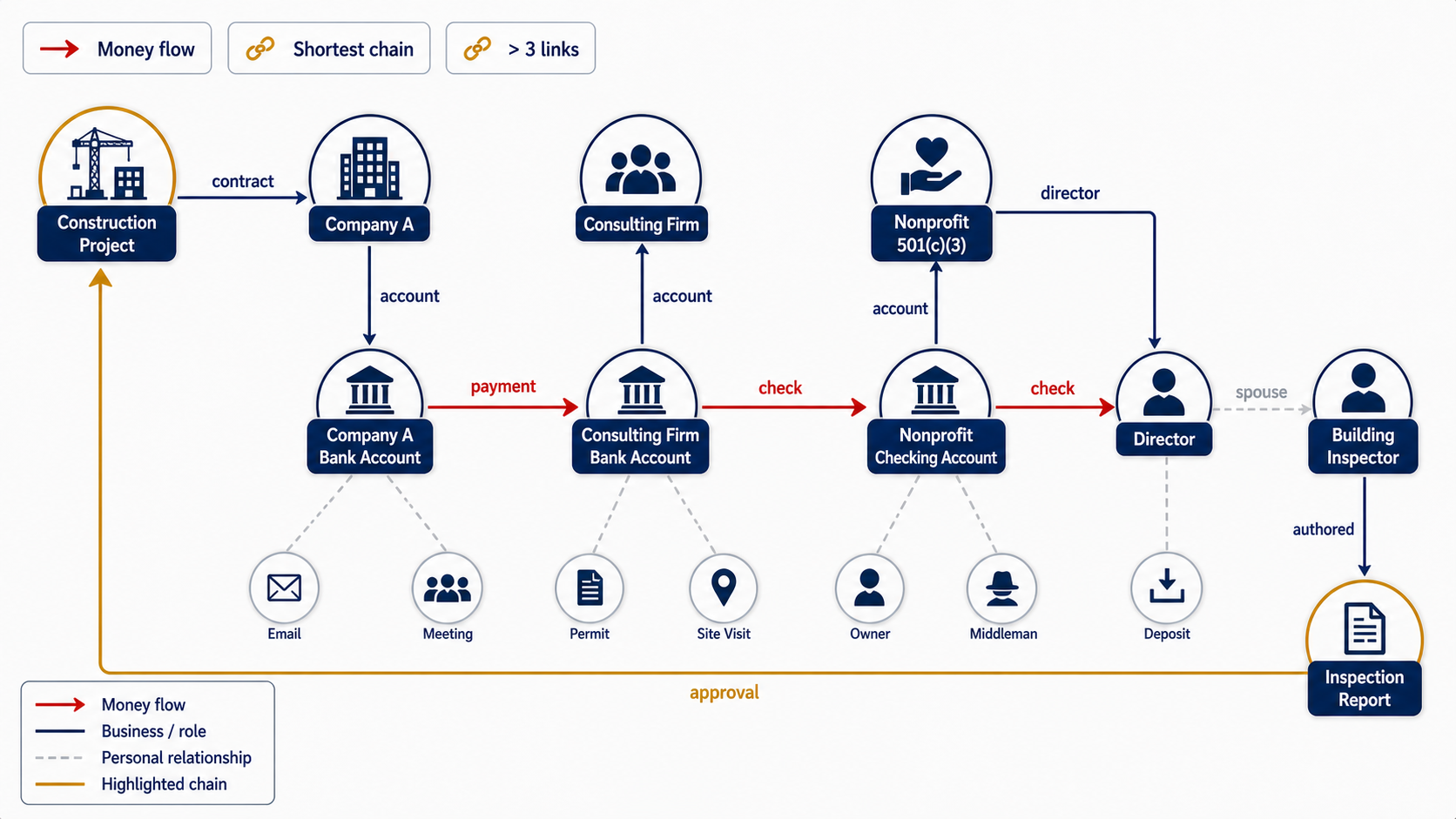
Some of the most important relationships in a case are indirect and spread across multiple records.
Once visualized, a chain may raise questions about control, notice, influence, bias, agency, ownership, conflicts, or further discovery.
CaseBuilder is not generic PDF storage. Its purpose is to turn disconnected discovery into visible case intelligence and usable litigation work product.
Maps connections between people, documents, dates, events, companies, agencies, providers, issues, locations, ownership structures, memberships, claims, defenses, damages, and missing records.
Visualizes relationship chains, shared entities, indirect connections, missing links, and evidence paths that may support discovery, deposition preparation, issue analysis, or case strategy.
Builds timelines from scattered records and links events to supporting documents, pages, people, providers, agencies, locations, and issues.
Connects documents and events to claims, defenses, damages, notice, causation, breach, standard of care, credibility concerns, and attorney-defined case themes.
Tracks incomplete productions, missing attachments, missing medical records, missing CAD logs, missing 911 audio, missing policies, missing signatures, missing Bates ranges, and other unexplained gaps.
Helps identify records that support a claim or defense, show notice, reveal inconsistency, contain an admission, expose a procedural failure, or create a deposition topic.
Maintains a structured index with source, date, category, page count, Bates range, review status, issue tags, witness tags, hot-document status, gaps, and linked timeline events.
Gives the legal team a high-level view of document counts, review status, hot documents, missing records, open issues, key events, witnesses, providers, agencies, timelines, and export status.
Supports attorney-ready work product, including indexes, chronologies, hot-document lists, issue maps, gap reports, exhibit folders, and summary packets.
The workflow begins when a firm provides eDiscovery data. CaseBuilder ingests the material, parses each document, classifies data types, maps the extracted data into its SQL database, and establishes connector types between the data points.
It does not replace attorney judgment, legal analysis, or strategic decision-making. It helps attorneys see the factual structure of the case faster, ask better questions, and focus review where it matters most.